



Why do so many villages in Thassos share the same name? A story shaped by pirates
Pirates played a major role in shaping the villages of Thassos. From mountain settlements hidden from coastal raids to the creation of the island’s famous “Skala” villages, the history of Thassos pirates can still be seen across the island today.
If you spend a few days in Thassos, you might start to notice something curious.
Names repeat.
Potamia, Skala Potamias.
Prinos, Skala Prinos.
Maries, Skala Maries.
At first, it almost feels confusing.
But this pattern is not a coincidence. It is the result of centuries of rich history, shaped by something that once defined life here: pirates.
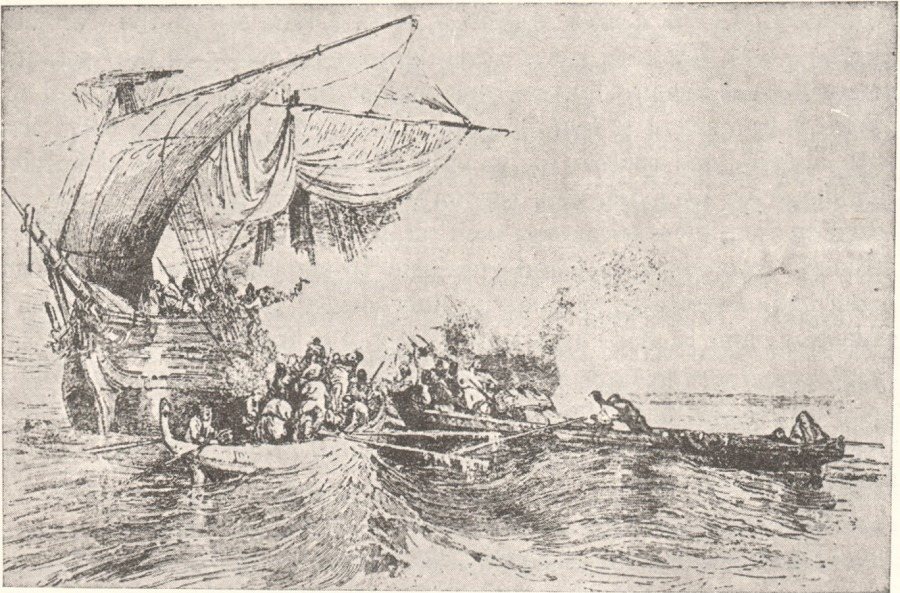
A coastline that was never entirely safe
For most of its history, starting from its official foundation in the early 7th century BC (around 680-670 BC) by Parian settlers, Thassos was deeply connected to the sea. Trade, fishing, movement, everything depended on it.
But the same sea also brought danger.
From the early Byzantine period, especially around the 9th and 10th centuries, piracy in the Aegean increased significantly. In 904 AD, after the sack of Thessaloniki, Saracen and Arab pirates moved across the region, reaching Thassos and leaving destruction behind.
These were not isolated events. Raids continued for centuries, intensifying again during the Ottoman period. Ships were attacked, coastal settlements were looted, and life near the sea became uncertain.
Moving uphill: how villages were reshaped
Faced with constant threat, the island’s inhabitants made a decisive change.
They moved.
Instead of living along the coast, they gradually abandoned exposed seaside settlements and built new villages higher up, in the mountains. Places like Theologos and Panagia were not chosen for views or scenery, but for protection.
Hidden among trees, set away from direct sight of the sea, these villages offered their inhabitants valuable time. Time to see danger coming, time to react.
Along the coast, only a few people remained. Watchmen would scan the horizon and warn the villages whenever unfamiliar ships approached.
Life reorganised itself around caution.
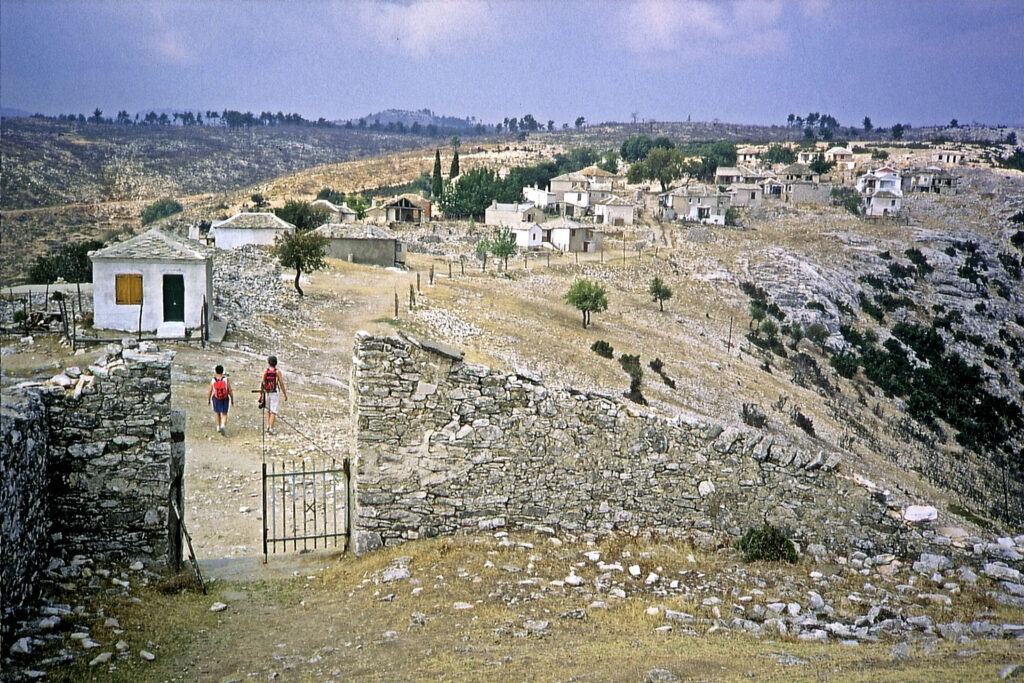
The origin of “Skala” villages
As the years passed and conditions slowly stabilised, people began returning to the sea, but differently this time.
Instead of rebuilding full settlements on the coast, they created smaller port areas, connected to their mountain villages. These became the “Skala” villages.
In modern Greek, “Skala” usually means stairs or a ladder. Historically though, the word was also used to describe a landing point, port, or small harbour connected to a settlement. This usage likely stems from the Venetian or Italian scala, which can mean a ladder or a landing stage.
So each inland village developed its own coastal extension:
- Potamia → Skala Potamias
- Prinos → Skala Prinos
- Sotiras → Skala Sotiros
These were not separate places in the beginning. They were functional extensions of the same community, connected by a single road running from the mountain down to the sea.
Even today, if you follow these roads, you can feel that connection. One continuous line between two worlds.
Life between mountain and sea
For generations, daily life in Thassos island existed between these two points.
The mountain village offered safety, tradition, and permanence.
The coastal “Skala” offered access, trade, and movement.
Today, this dual identity is what makes the island so unique. You can spend your morning exploring the stone-built alleys of a mountain village and your afternoon by the sea. At Endless Blue, we feel privileged to be part of this landscape, where centuries of history meet the calm rhythm of the Aegean.
A quieter island, shaped by a restless past
Piracy gradually declined after the early 19th century, especially when the island came under more stable administration. This brought a relative calm that allowed Thassos to thrive again.
But the marks of that restless era never disappeared. They remain in the layout of the villages, in the steep roads that connect the heights to the harbor, and in the names that repeat like a local chant.
Seeing it today
Today, most visitors arrive for the beaches, the clear water, the green.
But if you look a little closer while exploring Thassos, you begin to notice the pattern.
A village above.
A “Skala” below.
A road connecting them.
What once existed for protection now simply feels natural. Even today, many locals still refer to the mountain village and its Skala almost as one place, despite the distance between them.
And without realising it, you are moving through a landscape shaped by centuries of adaptation.
A different way to experience the island
Understanding this small detail changes how you see the island.
It is no longer just a collection of beaches and villages.
It becomes a place with depth, with layers, with stories hidden in plain sight.
And maybe that is part of what makes Thassos feel the way it does today.
Simple on the surface.
But quietly shaped by everything that came before.
