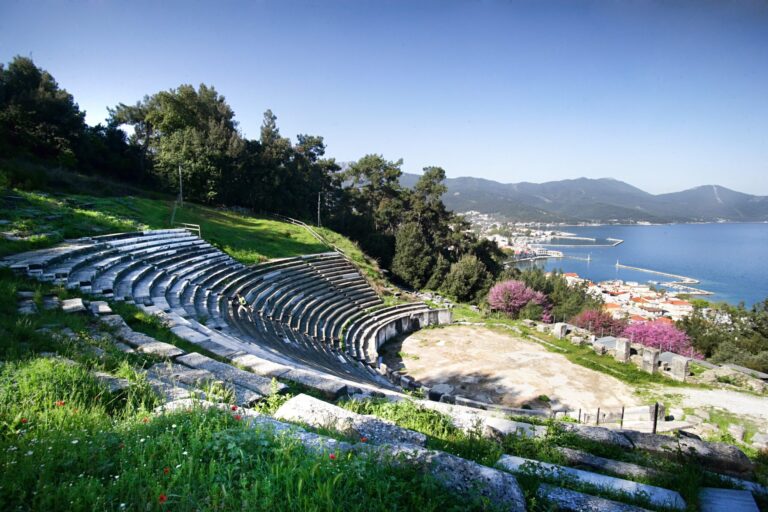
Most visitors come to Thassos for the pine trees and golden beaches. However, in ancient times, people came for the gods. Above the harbor of Limenas, history unfolds at every step—from the shrine of a goat-footed god and the ancient theater dedicated to Dionysus, to the cult of Heracles.
The Prince Who Could Not Go Home
According to mythology, Zeus—disguised as a bull—carried off Europa, daughter of King Agenor, to Crete. Agenor sent his sons to find her with strict instructions never to return without her. Thasos, son or grandson of Agenor (or, in other versions, a son of Poseidon), sailed north until he discovered a lush island off the coast of Thrace. He never found Europa, but he found a mild climate, dense forests, and gold, and decided to stay. The island took his name, while over the centuries it was also known as Aeria (for its clean air), Aethria (for its clear sky), and Chryse (for its mines).
From the Phoenician Melqart to Apollo and Pan
The Heracles of Thassos: The Thasians honored the twelve Olympians, but their patron was Heracles—who, as Herodotus confirmed, was originally connected to the Phoenician god Melqart of Tyre before becoming “Hellenized”.
The White Temple of Apollo: The acropolis was dominated by the temple of Pythian Apollo, so white that it shone from afar over the town.
Pan on the Third Hill: On the third summit of the acropolis, inside a niche carved into the rock, lies a 4th-century BC relief depicting Pan playing his pipes among goats.
Dionysus, Wine, and a Theater with a Unique View
Thassos was famous for its exceptional wine. Its earliest coins depicted a satyr and later Dionysus himself alongside Heracles. The ancient theater of the island, dedicated to Dionysus, still offers panoramic views of the sea today. The tour concludes ideally at the Archaeological Museum of Limenas, which houses an impressive 3.5-meter kouros and the famous 480–470 BC wine quality law.
The Island Where the Gods… Relocated
On Thassos, traditions do not disappear; they simply evolve. Around 680 BC, Greeks from Paros built a brilliant marble city here. Later, Christians erected churches over the foundations of ancient temples (such as at Alyki and Evraiokastro). During the era of pirates, residents sought safety in the mountains, creating the characteristic duality of many settlements: a village high up in the mountains and its “Skala” down by the sea. Even the white marble of Thassos traveled through time, reaching as far as the Kasta Tomb in Amphipolis.
Mini Guide: How to Experience Thassos Like a Local
Ancient Agora & Museum: Located side by side in Limenas for a complete cultural walk.
Acropolis: Best visited in the early morning or late afternoon, wearing comfortable shoes for the stone steps.
The Ancient Theater: Check if it is open for visits before heading up.
Old Harbour: The ideal spot for sunset, right next to “Kalogeriko” and the remains of the ancient military harbor.
History's First Guest Who Never Checked Out
Thasos went looking for Europa and found a blue that never ends. The search ended there, but the magic of the blue continues. Rightly considered history’s first guest who never checked out.
At Skala Potamia: Endless Blue Sea Resort
At Skala Potamia, right on the golden beach with Mount Ypsarion rising impressively behind it, even a prince on a mission would forget his destination. Check in at Endless Blue Sea Resort, where “just until tomorrow” always turns into “one more day”.